TRANSMISSION 03 / ALPHA DEVELOPMENT JOURNAL / 11 OCTOBER 2026
Ten Million Stars: Turning Catalogue Data into a Playable Frontier
How catalogue data becomes geography, discovery and history.
Stars. One reptiloid lifetime.
Catalogue records / expanding frontierFROM A POINT OF LIGHT TO A REASON TO TRAVEL
Astronomical identity, fictional history and the choices between them.
▶ PLAY LOOP■ STOP LOOP · 8 SECONDS


A star begins as a point of light. A frontier begins when you have a reason to go there. For Gornverse, the challenge is turning a catalogue of ten million stars into choices a reptiloid explorer can understand: where to travel, what to investigate, and what to bring home.
01 / Real stars. A fictional future.
Our astronomical foundation uses Gaia DR3 source identities. Those records give the map a traceable stellar identity and spatial structure. Distances and available stellar properties help make the frontier feel like a place with geography, rather than a cloud of interchangeable destinations.
Over that foundation sits Gornverse’s fictional civilization in 2402 and beyond: settlements, factions, stations, derelicts and the histories of those who reached them. The distinction matters. An astronomical record describes a real source; an alien metropolis or contested outpost belongs to our game’s fiction.
“Ten million” describes the catalogue foundation. It does not mean ten million handcrafted, fully playable worlds. We are developing richer destinations and interactions in layers, beginning with the places where an explorer can make meaningful decisions.
Two layers / Design overview
Catalogue identity · position · available stellar properties
Real-source data gives the map its geography.
Settlements · factions · discoveries · authored encounters
Fiction and game design give the journey its meaning.
02 / Give every destination a question
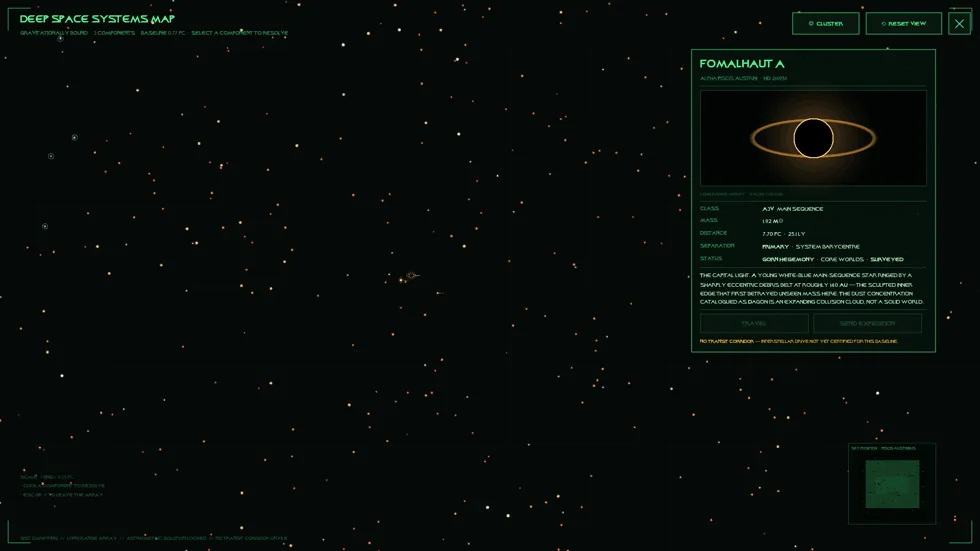
A useful map does more than tell you where a star is. Our system-card design asks: what is known here, how far away is it, who has a presence, what could threaten the expedition, and what remains uncertain?
That turns browsing into planning. A familiar route might be the sensible choice when your ship needs supplies. A poorly understood signal might be worth the detour when you have the equipment to investigate. The same destination can mean something different to a cautious surveyor and a crew hunting for lost infrastructure.
The current alpha already includes the Deep Space Systems map and Fomalhaut travel. The wider catalogue provides room for expansion; the detail and accessibility of destinations continue to develop. A point on the map and a completed expedition destination are different stages of that work.

03 / Discovery should change what you know
Our exploration design progresses from catalogued information through remote surveys, probes, visits and deeper mapping. Each stage should reveal useful evidence: a safer approach, an overlooked object, a hazard, or a reason to prepare differently next time.
Consider a faint signal beside an established route. In the design, a remote survey could narrow its location; a probe could resolve debris or interference; a visit could turn that uncertainty into an encounter. This is an illustrative exploration sequence, rather than a report of a completed mission.
The goal is to make knowledge valuable. Exploration can reward patience and preparation even when there is nothing to fight. A new route or reliable warning can matter as much as a recovered artifact.
Discovery sequence / Illustrative design
- 01 / CATALOGUELocateBegin with known stellar information.
- 02 / SURVEYQuestionLook for a reason to investigate.
- 03 / VISITDiscoverTurn a signal into an encounter.
- 04 / RETURNRememberCarry knowledge into another decision.
04 / Build wonder with restraint
Authored locations give the frontier memorable identities. Procedural systems are being developed to connect encounters and opportunities to stellar context, travel access, faction presence and rarity. A strange discovery should earn its strangeness; a routine journey should leave space for anticipation.
We also want discoveries to leave a history. Survey information, expedition outcomes and local changes can become the starting point for another decision. Broader empire simulation and psychohistory remain in development. Their intended role is to connect local choices with longer consequences, with uncertainty visible to the player.
05 / The frontier grows through detail
Our next exploration posts will follow that work at the scale of one expedition: one map card, one survey, one destination. The catalogue gives us reach. What makes the journey worth taking is the moment when a distant light becomes a place you remember.
Your next signal: would you investigate an abandoned station, an unexplained transmission, or a route that no expedition has mapped?
KEEP THE FRONTIER ON YOUR RADAR
Wishlist Gornverse: The Dark Frontier on Steam and follow the development journal.
WISHLIST ON STEAM ↗GORNVERSE: THE DARK FRONTIER / © 2026 GornHegemony Management FZCO
Leave a Reply